Towns and counties we run in western NC
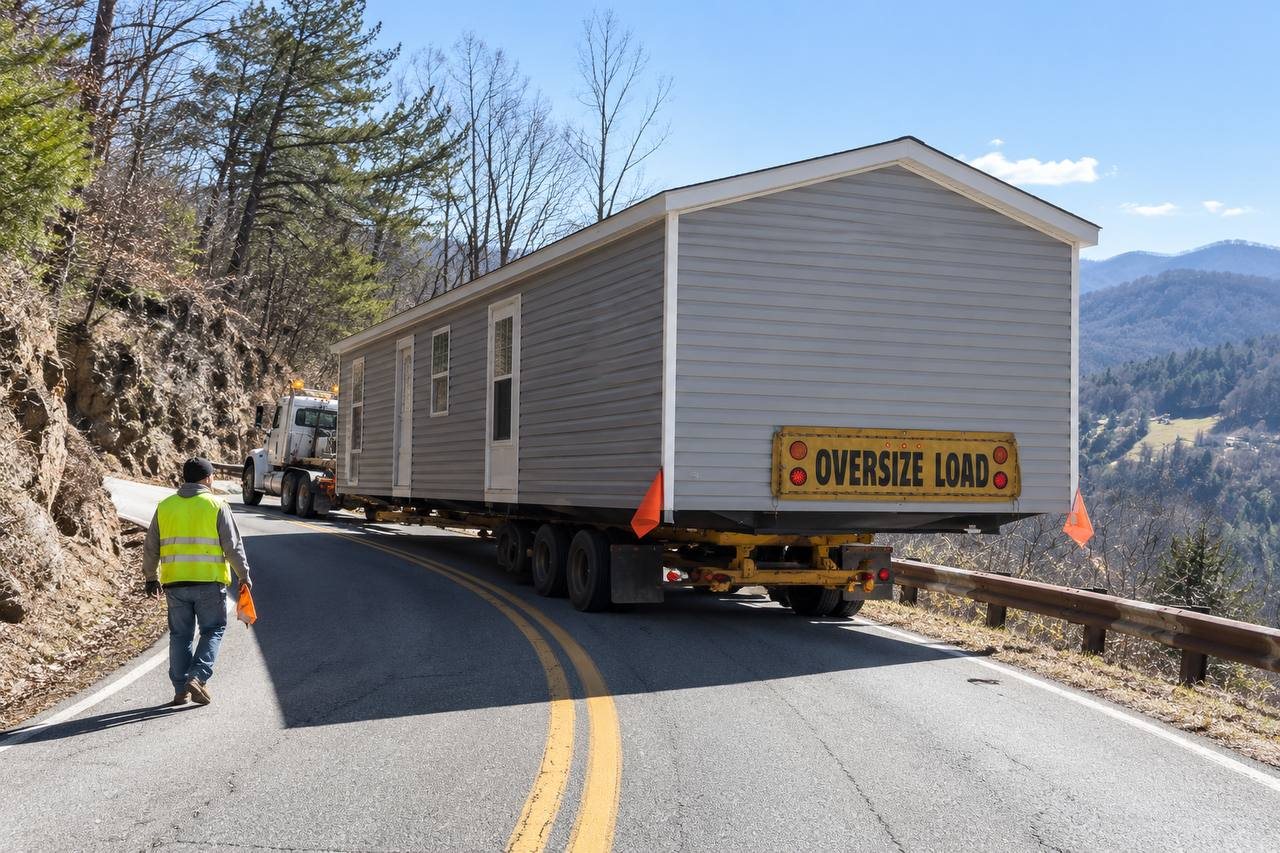
The manufactured housing in Buncombe County spreads from Asheville's outer corridors north to Weaverville, east along the Swannanoa River to Black Mountain, south through Arden and Fletcher toward the Henderson County line, and west into Candler and the Hominy Creek communities. That geography defines this crew's home territory, and it is mountain terrain throughout — not a qualifier attached to certain routes but the baseline condition of nearly every move in this region.
Beyond Buncombe's line, regular service covers Madison County to the north, McDowell County to the east, Henderson County to the south, and Haywood County to the west. Jobs into Yancey or Mitchell County are possible and quoted by the mile rather than the county standard rate. A 12-mile pull from Swannanoa to Black Mountain and a 40-mile pull from Asheville into Madison County are both serviceable — they are not the same price, and the grade on mountain corridors adds time and equipment demand that flatland carriers do not factor into their base rates.
When someone types mobile home movers near me from one of these communities, the question underneath it is whether this route is common enough to price competitively. In the counties listed here, it is. Manufactured homes move regularly through all of them, which keeps the crew familiar with the permit requirements, road conditions, and site access patterns that make western NC moves distinct from jobs on the Piedmont.
What a local move costs in Buncombe County
Transport cost in this region breaks down by home size and scope. The table below maps the most common combinations; the full line-item breakdown is at mobile home mover prices.
| Scope | Typical Range | What drives the number |
|---|---|---|
| Single-wide, transport only | $3,000–$8,000 | Short in-county pull at the low end; distance, mountain road grade, or pre-move prep push toward the top |
| Double-wide, transport only | $7,000–$15,000 | Two-section move; escort and permit costs compound with distance and terrain |
| Single-wide, transport + setup | $5,000–$12,000 | Adds blocking, leveling, Wind Zone I tie-downs, and utility reconnection to the transport cost |
The cheapest job in western North Carolina is a short in-county pull of a home that is already road-ready — tires inflated, lights wired, title clear, property taxes current, and the destination lot reachable off a paved county road without special access work. A single-wide in that condition on a 10-mile Buncombe County route can land near the $3,000 floor. Shift any one of those variables and the number climbs toward the middle or top of the range. The specific math for single-wide jobs, including what each add-on typically costs, is at cost to move a single-wide mobile home.
What moves a quote toward $8,000 or higher
In the ridges and hollows of western NC, the gap between a $3,500 move and an $8,000 move of the same home type often comes down to variables the owner controls before booking. Five factors drive the number, roughly in order of impact:
- Distance and road grade. Miles are the baseline, but Buncombe County roads earn their terrain. Several routes that look short on a map require a preliminary survey because of grade, curve radius, or overhead clearance. A move through Fairview's switchbacks is a different logistics problem than a level pull from Woodfin to Weaverville, and the crew prices them differently.
- Home size and configuration. A 14-foot-wide single-wide and a 28-foot double-wide require different permits and, for the double-wide, two separate transport sections moved in sequence. The NCDOT oversize/overweight permit requirements differ accordingly, and the per-section costs on a double-wide add up.
- Axle, tire, and hitch condition. A home that is not road-ready at departure requires preparation that was not in the original quote. Crews that inspect before booking rather than on move day protect against that outcome — ask when the inspection happens.
- Permit and escort fees. NC law requires permits before any manufactured home moves on state-maintained roads. In Buncombe County, load width on certain mountain corridors also triggers pilot car escort requirements, and those fees pass directly through to the job total.
- Destination site access. A level lot off a paved county road is the easy case. A lot with a steep gravel drive, a narrow access corridor, or a site that needs grading before the home can be placed all add cost that no honest carrier can quote without first seeing the lot.
Permits, wind zone, and what NC requires at setup
Moving a manufactured home in North Carolina runs through two permit tracks before the home can legally leave its current location. The owner obtains a tax-paid moving permit under NCGS Chapter 105, Article 18, which requires the county tax office to certify that property taxes on the home are paid and current. The carrier pulls the transport authorization under NCDOT Publication MH-2, the oversize/overweight permit governing routing, timing, and load limits on state-maintained roads. Both permits must be in hand before departure; a move that starts without the tax certificate is a compliance issue, not a paperwork formality.
At the destination, setup must meet the standards enforced by the NC Office of State Fire Marshal's Engineering and Building Codes Division. That includes foundation blocking, leveling, and tie-down anchoring. Buncombe County falls under HUD Wind Zone I per 24 CFR 3280.305, the minimum anchor and tie-down specification governing any manufactured home installed here. The county has recorded 19 federally declared disasters over 1973-2026, including hurricane declarations in 2020, 2021, and 2023, a tropical storm in 2024, and a winter storm in 2026. Wind zone compliance at setup is not a formality in a county with that weather record.
Allow at least one week between booking and move day for a clean job. The tax clearance certificate is the variable most likely to add time; owners who have deferred property tax payments sometimes find that clearance takes longer than the move itself to arrange.
Three questions that keep a move quote honest
"Is the home inspected before the quote is final, or after?" Axle condition, tire pressure, and hitch integrity all affect whether the home can roll safely. A quote that does not address them tends to surface surprises on move day. "Which permits are included, and who pulls them?" The NCDOT transport permit and the tax-paid moving certificate both have to be in hand before departure. A quote that does not account for them is not complete. "Have you seen the destination lot?" In Buncombe County, the destination is often the harder variable. A gently graded lot in Woodfin and a mountain lot in Fairview with a tight driveway are not the same setup job and cannot be priced the same without a site visit.
Once those questions are answered and permits are in order, booking follows: confirm the move date, arrange utility disconnects at the origin and reconnects at the destination, and confirm the new lot is accessible on the scheduled day. The full picture of what transport involves — equipment, routing, timing, and what happens at each end — is at mobile home transport.