What Buncombe County movers actually charge
Buncombe County holds more mobile and manufactured homes than any other county in western North Carolina — Census Bureau ACS estimates put the count around 16,047 units, spread across the Swannanoa Valley, the Reems Creek corridor, and the hollows north of Weaverville. That concentration supports a working local market with enough completed moves to anchor real price ranges, even if no two jobs look exactly alike.
The table below separates transport-only pricing from full-service pricing that adds blocking, leveling, and tie-downs at the destination. Transport-only covers disconnecting the home at the origin, the haul itself, and dropping the home at the new site — not making it livable. Many homeowners budget these two phases separately. Both ranges reflect moves within Buncombe County or into a directly adjacent county; longer hauls add a per-mile charge on top.
| Scope of move | Typical Asheville-area range | What drives it |
|---|---|---|
| Single-wide, transport only | $3,000 – $8,000 | distance, road width, axle count |
| Single-wide, transport + setup | $5,000 – $12,000 | blocking depth, Zone I tie-downs, utility prep |
| Double-wide, transport only | $7,000 – $15,000 | escort car count, section permits, road grades |
These are working ranges from a local market, not contractor quotes. A mover who offers a firm number over the phone, without walking your pull-out route or visiting the destination lot, is pricing a guess.
Mountain access and what it does to the number
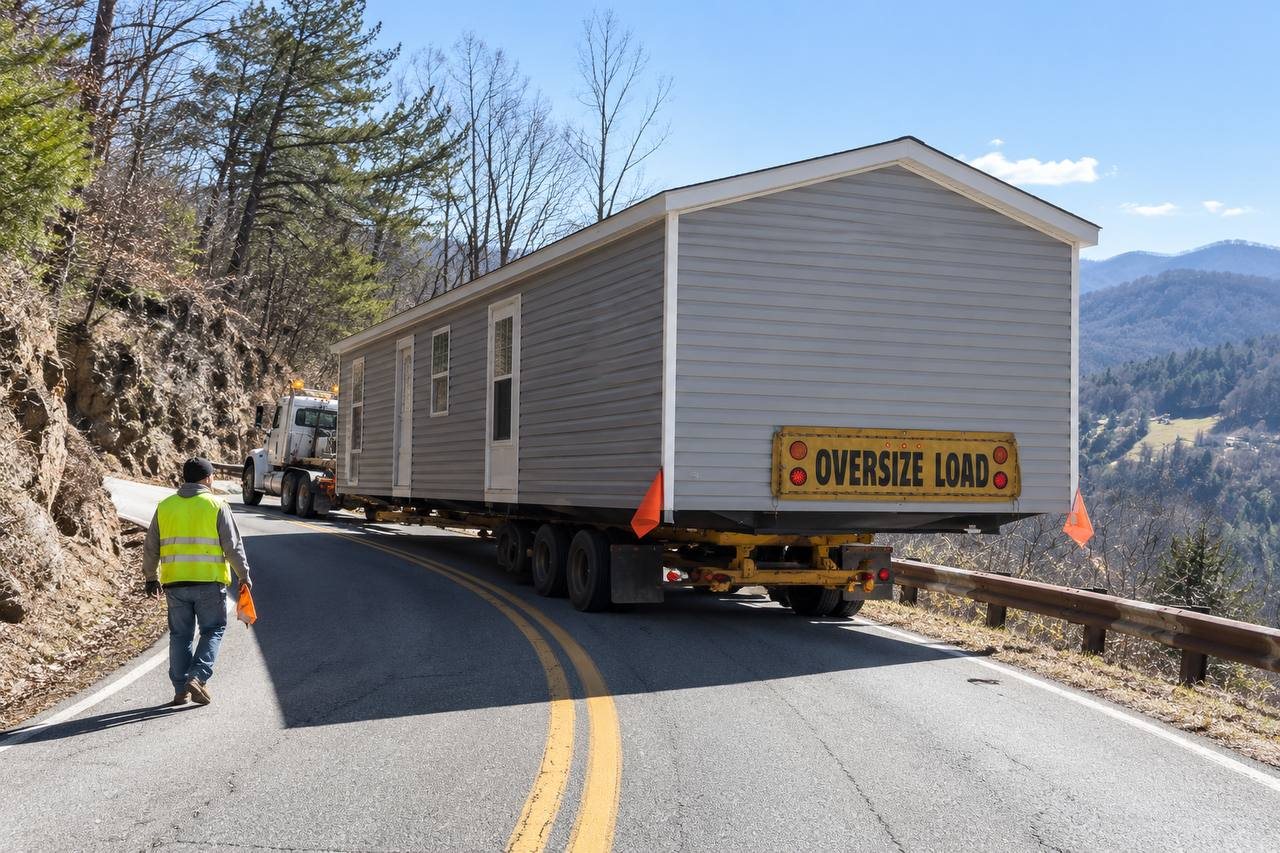
Buncombe County terrain is the variable that separates an Asheville quote from a flatland quote. Ridge lots above Leicester, narrow hollows near Black Mountain, and single-lane secondary roads throughout the county create routing constraints that generic online estimates never account for. A double-wide that is a straightforward haul elsewhere can require a push truck on a Buncombe grade, an extra escort car through a tight gap on a rural route, or a detour that adds an hour each way — none of which show up in a national average.
Distance compounds differently on mountain moves too. Most operators build a per-mile rate into transport quotes for moves beyond a base threshold, and on winding mountain roads the driving distance between two points is often considerably longer than the straight-line figure. A home relocating 15 road miles through the Swannanoa Valley to a site east of Black Mountain is a materially different job than a 15-mile move on a corridor highway.
Route scouting is not optional here. A responsible mover drives every mile of the pull-out path before pricing the job, because a mountain secondary road that looks passable on a map can hide a low-clearance bridge or a grade that stops a loaded rig. If a bidder has not asked for both the full origin and destination addresses before quoting, they have not scouted the route.
Weather timing matters as well. Buncombe County has seen 19 federally declared disaster events spanning 1973-2026, including a Winter Storm in 2026, a Tropical Storm in 2024, and Hurricanes in 2023, 2021, and 2020 — storms that have periodically closed rural secondary roads. A late-summer move should carry a weather contingency; an overnight hold with the home on the rig is not a common outcome, but it is a real one on a road that washes out.
NCDOT permits, escort rules, and the NC tax requirement
Moving a manufactured home in North Carolina means satisfying three overlapping requirements before the truck leaves the lot. Skipping any one of them is not a shortcut — it is a liability.
NCDOT oversize transport permit. Every manufactured home on a North Carolina road is an oversize load. NCDOT Publication MH-2 governs mobile and modular home transport — width allowances, time-of-day movement windows, and escort vehicle requirements. Loads wider than 14 feet require at least one escort; loads wider than 16 feet may require two, and some mountain routes carry additional restrictions beyond the statewide standard. The mover handles the permit through the NCDOT permitting system, but confirm it is included in the quote and ask to see the permit number before the truck moves.
Tax-paid moving permit. Before a manufactured home can legally move in North Carolina, the county must certify that property taxes on it are current and issue a permit under NCGS Chapter 105, Article 18. Outstanding taxes stop the move entirely. Allow at least one week to process this step before your target date — it is the requirement first-time movers most consistently underestimate. Title encumbrances can also surface here: if the home is secured by a deed of trust, confirm with your lender before scheduling.
HUD Wind Zone I tie-down requirements. Buncombe County is HUD Wind Zone I under 24 CFR 3280.305. That classification sets the minimum anchor count, spacing, and hardware specifications for manufactured home installation at the new site. Your installer must meet Zone I standards — not a lighter spec chosen for convenience. The National Weather Service wind-zone mapping that supports this federal classification is publicly available if you want to verify the county's designation before setup begins.
If the home predates 1980, have it tested before moving. The EPA requires proper identification and handling of asbestos-containing materials and lead-based paint when work disturbs them, and a move qualifies as disturbance work.
What setup at the new lot adds to the total
Transport delivers the home; setup makes it livable. On a Buncombe County lot — where finished concrete pads are less common and natural grades can be pronounced — setup typically involves more labor than the same work would require on a level prepared site.
Standard setup scope includes concrete or steel pier blocking to bring the home to finished-floor height; shimming and leveling to compensate for the grade; Zone I tie-down anchoring with straps and frame hardware meeting the 24 CFR 3280.305 specification; and utility connection points. Utility work itself — hooking to water, electric service, and sewer or septic — varies more than any other setup line, because what rough-in work is already waiting at the lot determines what the installer has to do. A lot with no rough-in at all is a materially different job than one where the previous home sat.
Skirting, steps, and any extra blocking adjustments for unusual grade changes are typically quoted separately from basic setup. Ask for the same line-item breakdown on setup that you demand for transport. The setup and installation guide details what each phase adds to the total and what to confirm before the installer leaves the site.
How to compare bids and keep the price honest
Four practices protect you when gathering Buncombe County moving quotes:
- Require a line-item breakdown. Transport fee, NCDOT permit cost, escort vehicles, fuel surcharge, blocking materials, tie-down hardware, and utility disconnection should each appear on their own line. A single lump number means you cannot see what changes when the job scope shifts on site.
- Ask whether the route was physically scouted. The question is direct: did someone drive the pull-out path before pricing this? A no means the quote is an estimate wearing a number's clothes.
- Confirm permit responsibility in writing. The NCDOT transport permit and the county tax-paid moving permit both need to be in hand before move day. Know which party is pulling each one, what the fee is, and whose name it carries.
- Use the table above as a reference. A bid outside those ranges is not automatically wrong — an unusually long haul, a large double-wide, or a genuinely difficult access road can all justify the upper end — but a clear, specific explanation of the deviation tells you far more than the number alone.
For a broader regional view, the mobile home moving cost guide covers the statewide picture. If you are still evaluating contractors, the Asheville mobile home movers page walks through what to look for in a mover for mountain-lot work specifically.