One in five homes in Yancey County is a manufactured unit
Yancey County carries one of the highest concentrations of manufactured housing in western North Carolina: about 2,249 units representing 19.9 percent of all homes, according to the U.S. Census Bureau ACS 2019–2023 (table B25024). In the hollows off NC-80, along the South Toe River corridor, and on the ridge parcels outside Burnsville proper, manufactured homes are the primary housing type, not an exception. That density shapes what local moves look like. Crews working this county know Yancey road conditions, the county permit process, and what it takes to position a home on mountain terrain that a flatland operator has never seen.
The jobs vary: a family relocating a single-wide from one parcel to another after a land sale, a landowner moving a double-wide down from a lot that flooded, a new buyer setting a home on a freshly cleared site off a ridge road. What they share is the mountain context and the equipment and paperwork requirements that follow. The transport overview covers the logistics of what a full move involves.
What a Yancey County move costs
Cost depends on three variables that Yancey County makes concrete: home size, haul distance, and terrain. A single-wide move on an accessible lot close to Burnsville sits near the lower end of the range. A double-wide that needs to be separated, hauled over a mountain road, and reassembled on a steep lot will approach the top.
| Job scope | Typical range |
|---|---|
| Single-wide, accessible lot, short haul (under 20 miles) | $3,000 – $5,500 |
| Single-wide, mountain terrain or longer haul | $5,000 – $8,000 |
| Double-wide, accessible site, local move | $7,000 – $10,000 |
| Double-wide, steep or restricted access, multi-section reassembly | $10,000 – $15,000 |
These ranges cover transport only. Site preparation, new skirting, utility reconnection, and anchoring are separate line items. The setup guide breaks those costs out. Any bid that bundles everything without separating the move from the setup cost is worth examining line by line.
Permits before the wheels turn
Two separate permit requirements apply to almost every manufactured home move in Yancey County. The first is the NCDOT oversize/overweight transport permit, issued under Publication MH-2, which governs routing, timing, and load requirements for any manufactured home moving on a North Carolina public road. Routing restrictions apply on mountain routes; some roads in and around Yancey County carry bridge weight limits or width constraints that require a path other than the most direct line on a map.
The second is the tax-paid moving permit required under NCGS Chapter 105, Article 18. Before a manufactured home can be legally moved, the owner must confirm that property taxes are current and obtain the required certificate. This step catches people off guard when they have inherited a home or recently acquired a parcel. A mover who does not walk you through both permit sequences is one who expects you to sort them out independently.
Mountain roads and what they add to a bid
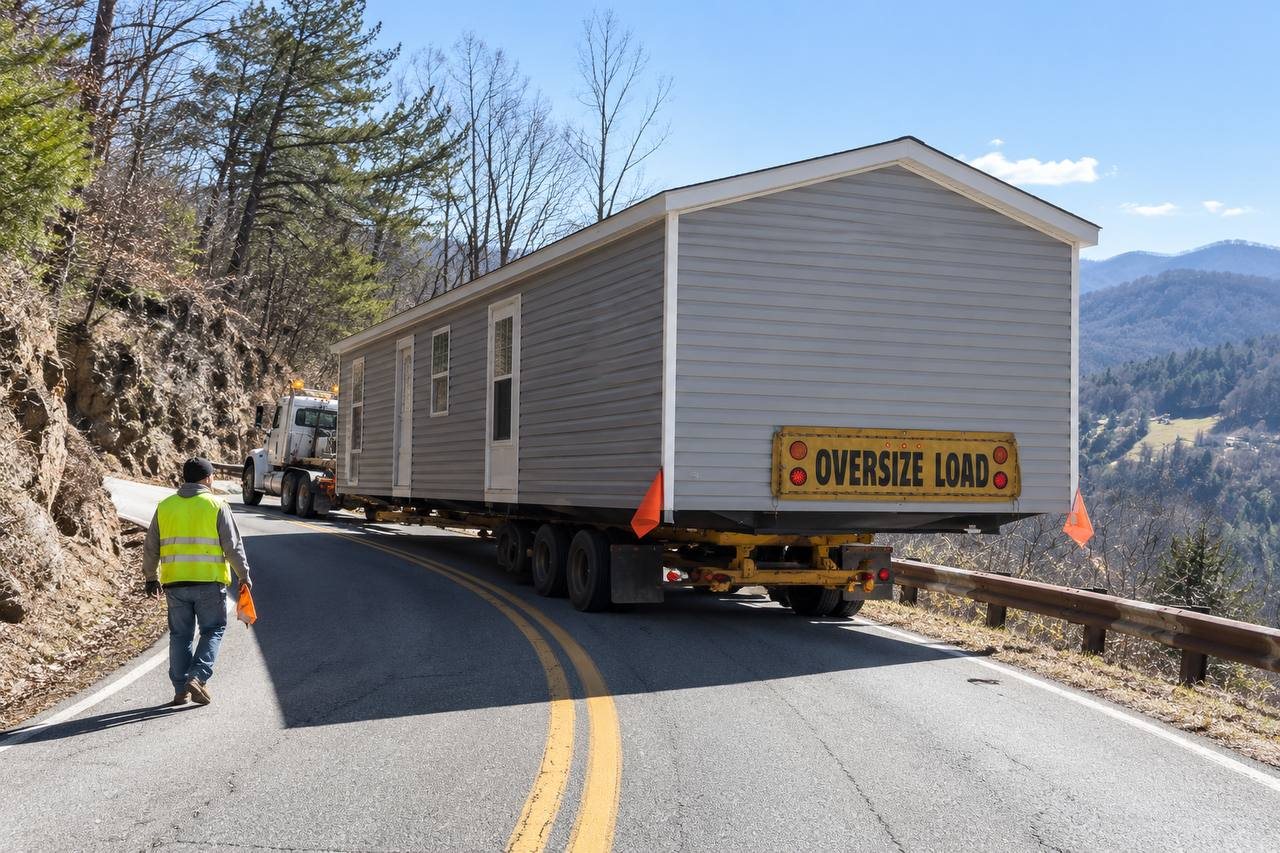
Burnsville sits at roughly 2,800 feet, and much of Yancey County climbs from there. US-19E and NC-197 carry most through traffic; the roads that reach individual parcels are often narrower, steeper, and more exposed to weather. A double-wide measuring fourteen feet wide needs clearance that some mountain two-lanes and their overhanging banks do not easily provide. Movers working this county route-scout before they quote, or they should. An estimate given over the phone without a site visit is rarely the final number once the driver has seen the actual approach.
Storm history plays into site assessment. Yancey County has recorded 21 federally declared disasters across 1978-2026, including hurricanes in 2020, 2021, and 2022 and a tropical storm in 2024 that affected road infrastructure in ways that persist on some county routes. A destination site on a flood-adjacent lot or on a road that has seen washout repairs deserves inspection before transport day. Use the form on the local movers page to flag access concerns when you first reach out.
Anchoring requirements that apply at every Yancey County site
Yancey County falls in HUD Wind Zone I under 24 CFR 3280.305, the designation that sets minimum anchoring and tie-down standards for manufactured homes installed here. Wind Zone I is the lowest-intensity classification, but that does not make anchoring optional or interchangeable. Mountain terrain creates localized wind exposure that a standard flatland installation pattern may not address, and the zone designation sets a floor for the system, not a finished specification. Any home moving to a new site in Yancey County needs anchoring designed for that specific lot.
Homes built before 1980 carry an additional consideration: those units may contain asbestos-containing materials or lead-based paint that require handling protocols established under EPA guidelines before and during the move. If the build year is unclear, verify it before scheduling transport rather than after. The county setup and inspection process that follows the move covers blocking, skirting, and utility connections; the setup page details what that step involves for a Yancey County installation.
Questions that separate prepared crews from out-of-area bids
Three questions cut through the noise when evaluating movers for a Yancey County job. First, ask whether they have moved a home on a road with terrain comparable to yours. Mountain experience is not the same as piedmont work, and a crew unfamiliar with steep access tends to underbid and recalculate on site. Second, ask who handles the NCDOT permit and the tax-paid certificate, and whether those are included in the quoted price. Third, ask what the quote covers for setup and who coordinates the county inspection after transport.
A full-service transport and setup crew handles disconnect, haul, and reconnect as a package. Breaking those apart sometimes saves money but creates gaps in accountability when something goes wrong between steps. If you are moving a home into Yancey County from out of state, ask specifically about interstate permit requirements before finalizing the schedule, because routing and paperwork differ depending on the origin point.