Nearly one in four Alexander County homes is a manufactured home
Drive any direction out of Taylorsville toward Hiddenite, up through the Brushy Mountain foothills, or along the Catawba River bottom, and you will pass manufactured homes on private parcels, in small communities, and on family land that has held the same structure for decades. About 3,999 of Alexander County's homes are manufactured units, roughly 24.8 percent of total housing stock (U.S. Census Bureau ACS 2019-2023, table B25024), one of the highest shares in western North Carolina. Whether you are moving one of these homes into the county, out of it, or between parcels within it, local knowledge about county roads, lot access, and the permit sequence matters more here than it does in a larger market.
The home's age shapes what the move involves before the truck ever arrives. Homes built before 1980 may contain asbestos-containing materials or lead-based paint. Federal rules under the EPA govern handling and disclosure requirements during transport; a mover who does not ask about build year and condition is skipping a step with real regulatory and health consequences.
What a move costs in and around Taylorsville
Around Taylorsville a single-wide move typically runs $3,000 to $8,000 and a double-wide runs $7,000 to $15,000. The spread inside each band is real: road access, distance, permit costs, and whether setup is included all move the number. The transport overview explains what each line item covers.
| Move scope | Typical range | What drives the cost |
|---|---|---|
| Single-wide, within Alexander County | $3,000 – $5,500 | Road access, permit fees, basic level and setup |
| Single-wide, across county lines | $5,000 – $8,000 | Distance, additional escorts, NCDOT oversize permits |
| Double-wide, within Alexander County | $7,000 – $10,500 | Sectioning, reconnect labor, wider-load handling |
| Double-wide, long haul or difficult access | $10,000 – $15,000 | Crane work, steep grades, restricted road access |
Items that catch first-time movers off guard: the NC Department of Transportation oversize transport permit required for any manufactured home on public roads, the tax-clearance moving permit that must be processed before transport day, utility disconnects and reconnects, and pier-and-pad preparation at the destination. A quote that omits any of these line items is incomplete, not cheap.
Permits and the tax-clearance step
Two state-level requirements govern nearly every North Carolina mobile home move and both must be resolved before the home rolls. First: under NCGS Chapter 105, Article 18, a tax-paid moving permit is required before transport. The county tax office must confirm that property taxes on the home are current before issuing the permit. This is a hard stop with no workaround and no retroactive clearance once the home has moved. Budget a few business days for the tax office to process the request.
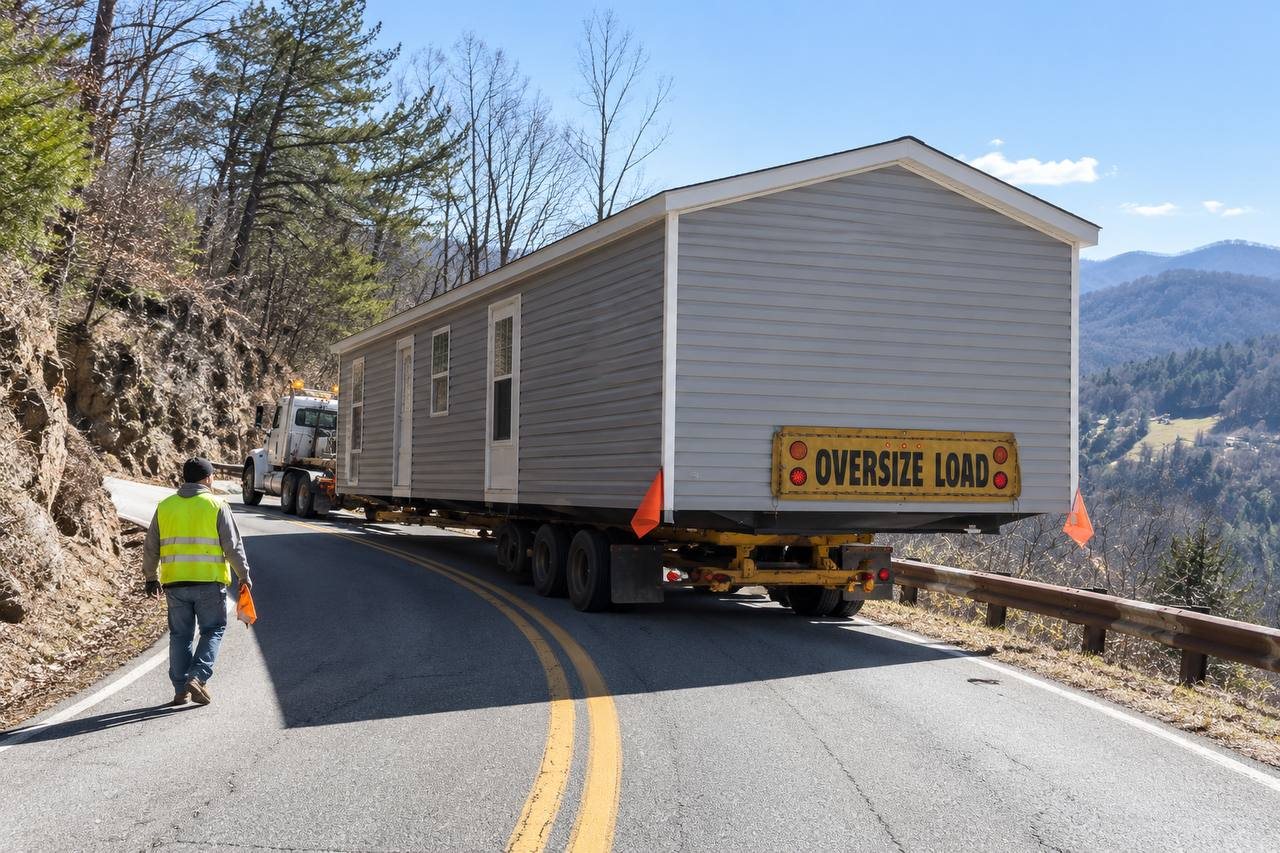
Second: the NCDOT Publication MH-2 oversize and overweight transport permit is required for any manufactured home moving on public roads. A single-wide crossing county lines needs it; so does a double-wide moving entirely within Alexander County if it travels a public road. Your mover should either pull this permit on your behalf or explain exactly what you need to obtain it. Beyond state requirements, Alexander County has its own destination setup permit and building inspection at the new site — your mover should know that local sequence and not leave it to guesswork on move day.
Anchoring and setup in Wind Zone I
Alexander County is designated HUD Wind Zone I under federal manufactured housing standards (24 CFR 3280.305). That designation sets the minimum anchor count, strap type, and spacing for any manufactured home installed in the county. The National Weather Service wind-zone maps that inform this standard place the Piedmont foothills in the lower-wind tier, but the record of severe weather in Alexander County in recent years makes proper anchoring a practical matter, not just a code one.
A home moved from a higher wind-zone county into Alexander County must still meet Zone I specifications at the new site. A home moving out of Alexander County to a higher-zone area will need anchor upgrades to meet those tighter standards. Either way, anchoring is part of setup, not an optional add-on. The setup and installation guide covers what the pier-and-tie-down inspection verifies and what to confirm before calling the job complete.
Storm history and the timing of your move
Alexander County has seen 16 federally declared disaster events over 1989-2026, including a Winter Storm in 2026, a Tropical Storm in 2024, a Hurricane in 2022, a Severe Storm in 2021, and a Hurricane in 2020. That record matters when planning a home move. Storms that bring wind and flooding test anchoring systems, shift piers, and expose homes that were not properly tied down after a previous relocation. If you are purchasing a home that was moved during this period and are unsure whether setup was permitted and inspected, requesting documentation from the county building office is worth the time before the next storm season.
From a scheduling standpoint, late summer and early fall in Alexander County overlap with active storm season. Any reputable mover will monitor the forecast and hold a transport if severe weather is imminent. Ask before you sign how your mover handles weather delays and whether the contract addresses rescheduling without added cost.
What to confirm before you book
The terrain around Taylorsville — hill lots climbing toward the Brushy Mountains, hollow roads off Highway 90 and Highway 16, parcels with limited turnaround space — requires a mover who has worked these routes, not one quoting from a map. Phone estimates based on home dimensions alone miss the site variables that determine actual cost and timeline in Alexander County. Before committing to a crew, ask for an in-person site walk at both origin and destination. That visit catches overhead clearances, tree limbs, grade problems, and access restrictions that add cost if discovered on move day.
Three questions that separate organized crews from underprepared ones: Do they pull the NCDOT transport permit, or does that fall to you? Do they initiate the county tax-clearance request, or do you? Do they schedule the anchoring inspection at the destination, or is that handed off? Vague answers mean the administrative work lands on you. For a broader look at service levels and how to compare quotes, see mobile home movers near me. For the destination side of the process, the setup guide is the right next read.