A county where one in four homes is a mobile home
According to U.S. Census Bureau ACS 2019–2023 estimates (table B25024), Swain County has approximately 2,157 mobile homes, making up about 25.3 percent of all housing units — one of the highest concentrations in western North Carolina. When a county's housing stock leans this heavily on manufactured structures, moving one is a regular part of local real estate: families relocating within the area, landowners replacing aging single-wides, park operators shifting inventory, and heirs settling estates all put homes in transit across Swain's roads every year.
Bryson City is the county seat of Swain County, sitting where US 19 and US 74 meet at the Tuckasegee River. That junction gives reasonable highway access for oversize loads, but most destination lots sit off state-maintained roads that narrow quickly into the Nantahala National Forest and surrounding private land. Crews who regularly move homes in this county plan routes differently than haulers unfamiliar with the grade changes here.
If you are searching broadly, the mobile home movers near me page covers the full western NC service area. This page focuses on what a Bryson City and Swain County move specifically involves.
What a Bryson City move typically costs
Distance and terrain are the two variables that move a quote up or down the range. A short haul across a flat park road looks nothing like pulling a single-wide from a hillside lot off US 19 onto a state highway. The table below shows typical price ranges for the most common job types in and around Bryson City. The full mobile home transport page breaks down each cost line in detail.
| Job Scope | Typical Range |
|---|---|
| Single-wide, local haul within Swain County | $3,000 – $5,500 |
| Single-wide, cross-county or steep terrain route | $5,000 – $8,000 |
| Double-wide, local haul within Swain County | $7,000 – $11,000 |
| Double-wide, long-haul or engineered mountain route | $9,500 – $15,000 |
Two items push a Swain County quote toward the top of its range consistently: a route that requires a NCDOT over-dimensional escort and a destination lot that needs grading before the home can be leveled. A phone bid without a site visit misses both.
The permit stack before any truck leaves the lot
Two state-level requirements must be in hand before a manufactured home can legally move in North Carolina. The first is a transport permit from NCDOT. Publication MH-2 covers the full application, route requirements, and escort rules that apply to over-dimensional loads on state highways. Any mobile home wide enough to require flagging needs this permit before the truck turns a wheel.
The second is the tax-paid moving permit under NCGS Chapter 105, Article 18. Before a mobile home moves, the owner must obtain a certificate from the county tax office confirming that property taxes on the unit are current. This is not the transporter's responsibility to obtain; it belongs to the owner, and it is not optional.
At the destination, Swain County requires a setup permit and inspection before the home is occupied. The state regulatory authority for manufactured housing — including setup contractor licensing — flows from NCGS Chapter 143, Article 9A. Contractors performing setup work must hold an active license issued by the NC Office of State Fire Marshal's Manufactured Building Division; confirm that credential before any crew begins work on your lot. The inspection schedule affects your move-in date, so start the permit application early rather than the week before the truck is booked.
Grades, lot access, and what the route survey reveals
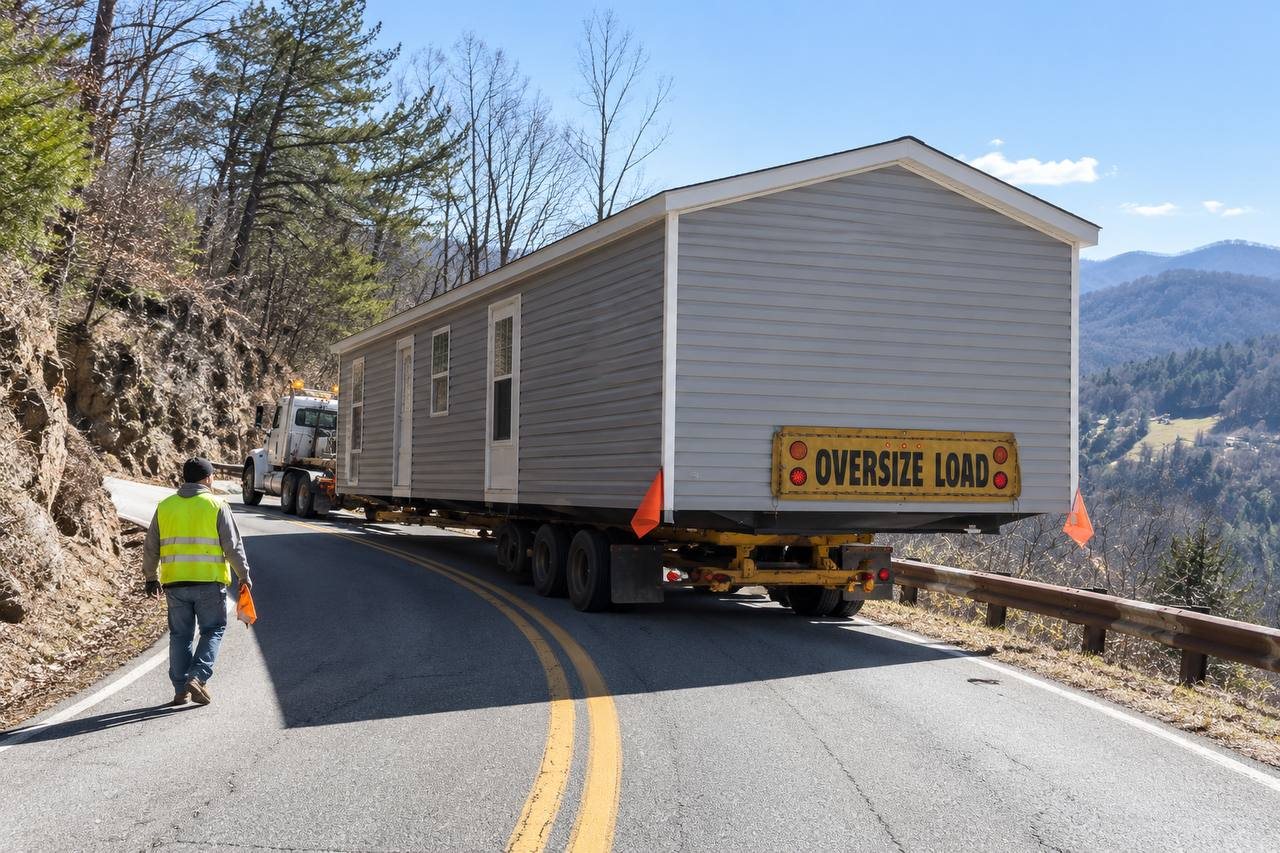
The Great Smoky Mountains Expressway (US 74) gives Bryson City a workable corridor for east-west oversize transport, but that corridor ends at the turn onto a private lane. A substantial share of Swain County's mobile homes sit on land reached by roads not built to accommodate a 14-foot-wide transport rig. Switchback grades, low utility-line clearances, creek crossings, and soft shoulders are documented variables on actual move days in this county.
A professional transporter will walk the route and destination site before quoting. The NCDOT permit process establishes the legal route on state roads, but physical clearance from utility companies (electric, cable, telephone) requires separate coordination and is the transporter's responsibility to arrange.
Double-wides in Swain County almost always must be separated into their two sections for transport and re-mated at the destination. That process adds labor, time, and a sequencing step that affects when the setup crew can begin work — something covered in detail on the mobile home setup page.
Storm record, wind zones, and anchoring requirements
Swain County has accumulated 15 federally declared disasters over 1993-2026, a span that includes Hurricane (2020), Hurricane (2022), Tropical Storm (2024), Fire (2025), and Winter Storm (2026). That record reflects the wind, water, and weather exposure that every installed home in this county faces over its lifetime.
HUD designates Swain County as Wind Zone I under 24 CFR 3280.305. Wind Zone I is the national baseline classification — it carries real anchoring requirements, not a pass on them. The HUD Office of Manufactured Housing Programs sets the federal construction and safety standards that define those tie-down and anchor-spacing requirements; any manufactured home relocated and set up in Swain County must meet them. A relocation is also the right moment to bring an older installation's anchoring up to current standard if it has not been inspected recently.
The National Weather Service wind-zone maps show the regional exposure data behind the HUD classification. Your installer will cite the applicable NC Residential Code requirement at permit time, but those maps explain why the standard applies to mountain counties like Swain.
Pre-1980 homes and what to resolve before moving day
A manufactured home built before June 1976 predates HUD's federal construction and safety standards entirely. Homes built between 1976 and 1980 meet early HUD standards but were produced before the phase-out of certain building materials. Moving either category physically stresses joints, panels, and roofing in ways that can disturb materials requiring careful handling.
The primary concern in pre-1980 homes is the possible presence of asbestos-containing materials or lead-based paint. The EPA's lead paint program publishes current federal guidance on assessment and handling for both; a move that involves separating a double-wide, removing skirting, or disturbing roof panels qualifies as work that warrants a pre-move assessment. Have it done before the crew arrives, not after they are already on site.
When you are ready to get quotes, have the home's year, dimensions, current address, and destination ready. A mover who does not ask for those details before quoting is skipping the information that determines the actual price.