What Buncombe County new-lot setups actually cost
Asheville-area lots rarely hand a setup crew a flat, dry pad. Most sites in and around Buncombe County carry some slope, and the full scope of a new-lot set covers blocking and leveling, anchoring and tie-downs, marriage-line work on a double-wide, utility connections, steps, and the county permit and final inspection. That full scope shapes the final invoice more than any single component. The table below breaks it out by what it typically costs here, split by home width.
| Scope | Typical range | What drives it |
|---|---|---|
| Standard single-wide set | $1,500 – $3,000 | blocking, leveling, anchoring, utility hookups |
| Standard double-wide set | $3,000 – $6,000 | marriage line, blocking, leveling, anchoring, utility hookups |
| Blocking and leveling | $400 – $900 | pad grade, pier count, shim work |
| Anchor and tie-down system | $350 – $800 | soil type, required depth, wind-zone class |
| Marriage-line work (double-wide) | $300 – $700 | span length, ridge beam condition |
| Steps and landing | $150 – $400 | height from grade, material |
The component rows overlap: blocking and anchoring happen together on the job, not sequentially, so they do not add to the all-in figures. A quote that stacks every component as a separate add-on deserves scrutiny. Transport to the new site is also a separate budget item; moving permits, oversize fees, and moving-day costs are not included above. Skirting is its own scope as well — the skirting cost guide covers what enclosing the base adds.
How mountain terrain shapes the blocking and leveling step
In the communities ringing Asheville, from the ridge lots above Weaverville to the creek-bottom sites outside Leicester, a setup crew reads the lot before anything else. A site with six to eight inches of fall over the length of the home requires more pier work and shimming than a pad engineered level. On cut-and-fill lots common to hillside developments, the soil under the downhill side may be compacted fill rather than native earth, which affects both pier spacing and anchor holding capacity.
Water compounds the terrain problem in ways specific to this area. Buncombe County has seen 19 federally declared disaster events over 1973-2026, including hurricanes in 2023, 2021, and 2020 and a tropical storm in 2024. Storm runoff on mountain lots can undermine a pad that appeared stable in a dry-season inspection. A site that pools water or drains toward the home will work against blocking and anchoring over time. Asking how the lot drains, and what the pad was built on, belongs at the quote stage rather than the warranty call six months later.
For the full sequence from site evaluation through final inspection, the mobile home setup guide covers what each step involves.
Wind zone, tie-downs, and what the inspector checks
Every manufactured home installed in Buncombe County must meet HUD Wind Zone I anchor requirements under 24 CFR 3280.305. Wind Zone I is the baseline federal tier, the appropriate designation for western NC's inland location, and it requires a complete over-the-top or frame tie-down system on every installation. The National Weather Service wind-zone maps that underlie those requirements place most of the Blue Ridge region in Zone I; the county setup inspector verifies the installed system against that standard before issuing any certificate.
The number and type of anchors required is set by the manufacturer's installation manual for that specific home, not by local convention. A double-wide carries more roof surface area than a single-wide and needs proportionally more tie-down points — part of why anchor cost tracks toward the top of its range on wider homes. Soil type also matters: native clay holds an anchor differently than fill material. On cut-and-fill lots, auger-type anchors that develop capacity through rotation are more reliable than driven stakes, and the evaluation of which type fits the site should happen before installation, not after a failed inspection.
For anchor types, spacing requirements, and what a compliant tie-down certificate covers, see the mobile home anchoring guide.
Permits, the tax-moving permit, and the utility hookup sequence
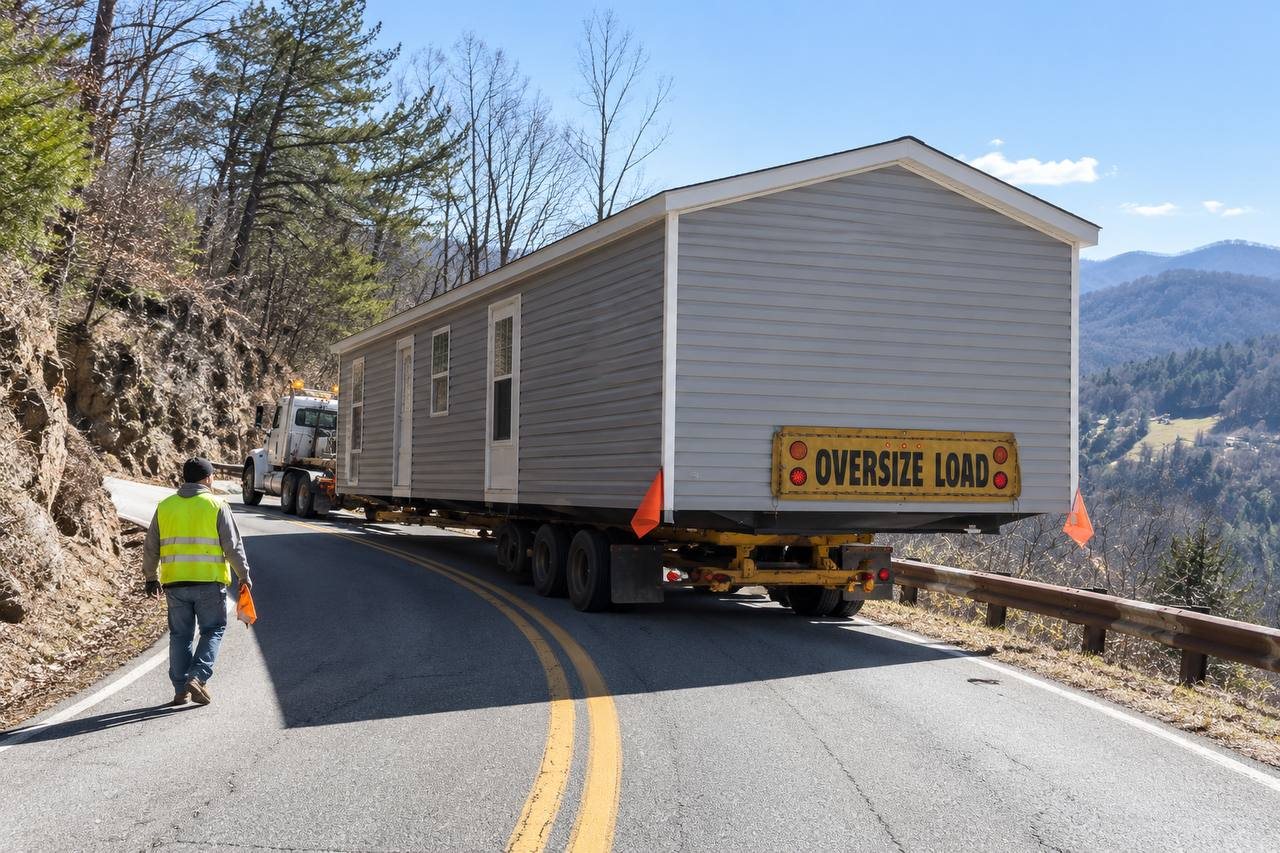
Setting a manufactured home at a new Buncombe County site involves two layers of permits, and order matters. If the home is being relocated from another NC county, a tax-paid moving permit is required under NCGS Chapter 105, Article 18; this document confirms that property taxes on the home are current before it crosses county lines. The transport itself requires an oversize-load permit from the state: NC DOT Publication MH-2 sets the routing, escort, and signage requirements for manufactured home moves on NC roads.
At the new site, the county setup permit governs the structural work. The inspector checks blocking height and spacing, anchor placement and torque, the marriage-line connection on double-wides, and utility rough-in. Until the inspection passes and a certificate of occupancy is issued, the power company will not connect permanent service. Scheduling the inspection before making the utility connection request, rather than assuming both will run in parallel, typically avoids a delay of several days in the current inspection queue.
Utility connections — water service line, sewer tie-in or septic connection, and the electric service entrance — are usually priced separately from the structural setup. Distance to existing risers and the condition of the meter base affect that cost; a lot that previously had a home on it typically has shorter runs than a raw lot starting from nothing.
How to compare setup quotes in this market
Three questions protect you when evaluating bids for a western NC lot:
- Has anyone walked the site? A quote produced from an address and a dimension sheet cannot accurately price blocking on a sloped lot. Grade, soil condition, and utility run distances all require a site visit before a number means anything.
- Is anchoring included or itemized separately? Some setup quotes bundle tie-downs into the all-in price; others add them at the final invoice as a change order. HUD Wind Zone I anchoring is required by code and verified at inspection, so confirm it is accounted for in the number you are comparing, not held in reserve.
- What does the permit line show? The county setup permit and inspection are a real cost. A quote that omits them has either buried them somewhere else or left the responsibility with you, and either way the expense surfaces before power is connected.
If the home was built before 1980, one additional step applies: the EPA publishes guidance on asbestos and lead-paint handling requirements for pre-1980 manufactured homes. Setup work that disturbs original materials — cutting, drilling, or removing components — may trigger notification or abatement requirements depending on what testing finds.
The skirting guide covers what enclosing the base adds once setup is done, and the full setup process page walks through the complete sequence from permit application to power-on.