Canton's manufactured housing picture
Haywood County carries more manufactured housing, proportionally, than most counties in western North Carolina. Census estimates put roughly 5,900 manufactured homes in the county, about one in every six housing units, and Canton accounts for around 186 of them, nearly one in ten homes inside city limits. Most people calling about a move here are not taking delivery of new inventory: they are relocating an existing home, settling an estate, repositioning after a land sale, or moving a family member closer in. That is the move this page is written for, whether you are coming into Canton, leaving it, or relocating within the county.
Single-wides make up the majority of Haywood County's manufactured housing stock, particularly on older rural lots in the creek hollows and ridgeline communities above the Pigeon River valley. Double-wides are more common on owned parcels with established utility hookups. That distinction shapes the disconnect scope, the transport complexity, and the sequencing of the county setup inspection at the destination site.
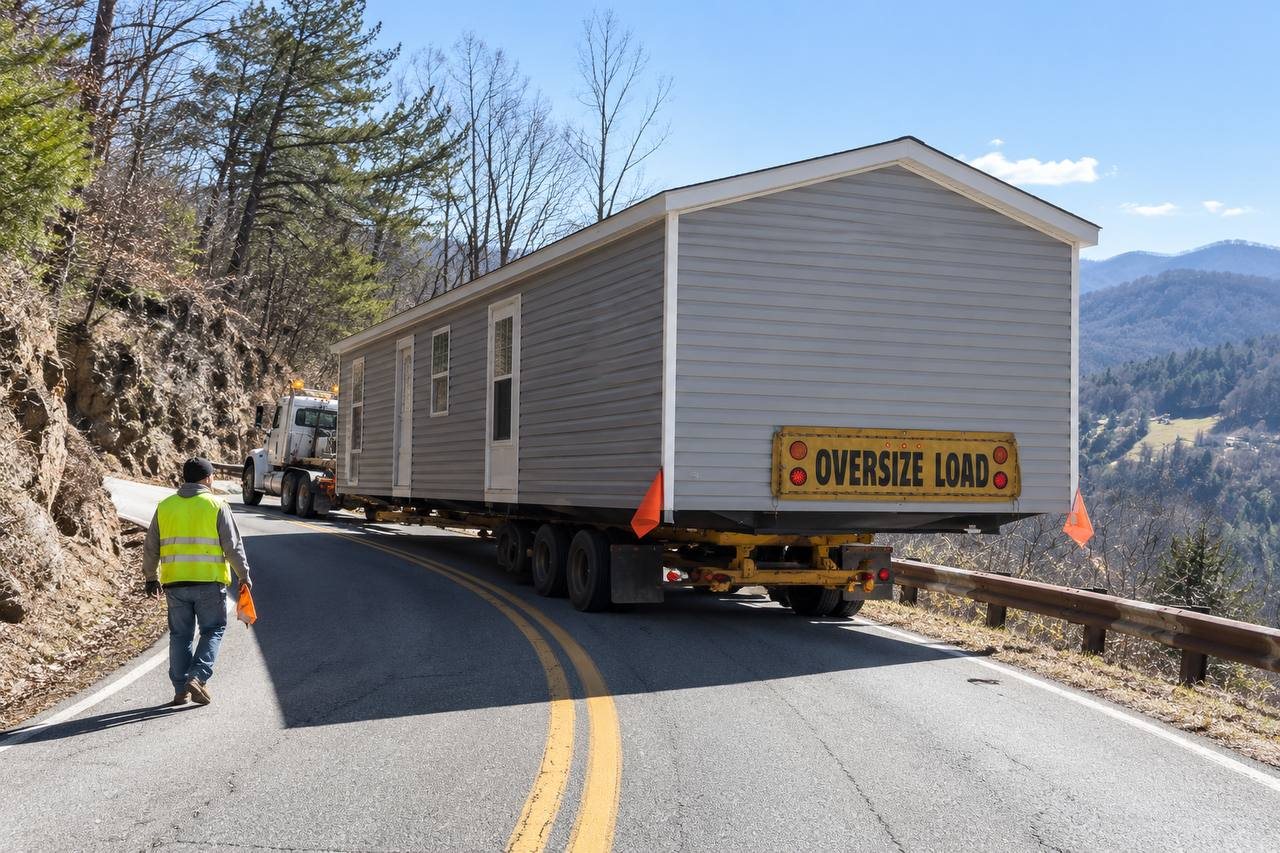
The Pigeon River valley that defines Canton's floor, the steep access roads climbing toward Beaverdam and Iron Duff, and the US-19/23 interchange routing through downtown all factor into how a driver plans an oversize load. A pre-move site survey in Haywood County is not optional: it confirms road width, overhead utility clearances, and the approach angle at the destination pad before the permit route is filed.
What a move costs around Canton
Price depends on home size, haul distance, road conditions on the pull route, and what the destination site requires at setup. The table below reflects working ranges for the most common mobile home transport scopes in and around Haywood County, not floor-scraping minimums or outlier worst cases.
| Move Scope | Typical Range | Main Variables |
|---|---|---|
| Single-wide, local haul (under 30 miles) | $3,000 – $5,500 | Road access, setup included vs. transport only |
| Single-wide, steep terrain or longer distance | $5,500 – $8,000 | Elevation change, permit routing, extra equipment |
| Double-wide, local haul | $7,000 – $10,500 | Disconnect, two-section haul, reconnect at destination |
| Double-wide, difficult access or longer haul | $10,500 – $15,000 | Narrow secondary roads, crane or specialized rigging |
| Transport only (no site setup) | Deduct $800 – $2,000 | Depends on which setup items are excluded |
Jobs requiring a pilot car escort, triggered by width thresholds in the NCDOT oversize permit rules, add to the base transport figure. Haywood County's elevation changes between the valley floor and higher-elevation lots can extend haul time even on relatively short distances. Keeping a move near the lower end of its range means a short haul, a maintained county road, and a level prepared pad already in place. The local movers guide lists the specific questions worth asking any contractor before committing to a quote in this county.
Permits and paperwork before wheels roll
Two documents are required before any licensed contractor moves a home on public roads in North Carolina. The first is the county tax-paid moving permit under NCGS Chapter 105, Article 18, which clears any outstanding property-tax lien on the home before it leaves the county. The county tax office issues it once the account is current; the contractor needs it in hand on move day. The second is an oversize/overweight transport permit from the NC Department of Transportation, governed by the requirements in NCDOT Publication MH-2. That permit specifies an approved route, which matters when a move crosses US-19/23, US-74, or any state highway through the Pigeon River corridor west of Canton.
The installer who sets up the home at the destination must hold a license from the NC Manufactured Housing Board (NCDOI). Licensing covers pier installation, tie-down systems, and utility reconnections, all of which require a county inspection before occupancy. The full step-by-step sequence is in the NC moving laws guide.
Road access and weather timing in Haywood County
The county's mountain terrain creates constraints that a flat-rate quote cannot capture. Loads over 14 feet wide require cleared sight lines around curves and adequate shoulder clearance on secondary roads. Access routes climbing from the Canton valley toward Crabtree, Lake Logan, Beaverdam, and Iron Duff are narrower than the county-maintained corridors near downtown. Whether the trailer can pull through or must reverse into a lot determines what rigging equipment the mover brings and how the permit route is drawn — a detail worth confirming in the site survey, not on move day.
Haywood County has recorded 19 federally declared disaster events spanning 1973-2026, including a Winter Storm in 2026, a Tropical Storm in 2024, and three hurricane-related events in 2023, 2021, and 2020. Those events repeatedly affected secondary road conditions in the communities where manufactured homes are most concentrated. Moves planned for late summer and early fall should carry buffer days; NCDOT oversize permits are route-specific and may need revision if a road is closed or damaged. Current road conditions are available through the NC DOT traveler information system before any oversize load departs.
Site setup, wind zone, and the inspection that clears occupancy
Haywood County sits in HUD Wind Zone I under 24 CFR 3280.305, the federal standard governing manufactured home installation design loads. That designation specifies the minimum anchor spacing and strap angles for the tie-down system at setup. A Zone I pattern is less intensive than the coastal Zone III standard, but it is a defined specification the county inspects before utilities can be connected. The licensed installer is responsible for meeting the standard; utilities connect after the county inspection clears, not before.
Homes manufactured before June 1976 predate the federal HUD Code entirely. Pre-HUD-Code homes can often be relocated, but a structural assessment before transport is a real step: older frames sometimes require added bracing to survive the haul without damage. EPA regulations covering asbestos and lead-based paint also apply to pre-1976 manufactured housing, and any work that disturbs siding, roof panels, insulation, or interior wall surfaces must follow those protocols. Flag the manufacture date to the contractor before the written scope is agreed and before any preparation work begins.